
The Alamo built the largest film set in North America outside Austin, and then lost the release.

Updated: Oct 4
TEXAS TOP 50; #46 The Alamo (2004)

If you are looking for where The Alamo was filmed, the answer is not San Antonio. John Lee Hancock’s 2004 film was shot on 51 acres of ranchland near Dripping Springs, about thirty minutes from downtown Austin, on a set of some seventy structures that was the largest ever built in North America at the time. Principal photography ran from January to June 2003.
Joe Leydon reported the build for Texas Parks and Wildlife Magazine in December 2003, while it was still standing. Production designer Michael Corenblith put the job in one sentence: “What we’re doing here is depicting the central event in the creation myth of this state.”
What was shot where.
The main set sat on the Reimers Ranch, now Milton Reimers Ranch Park in western Travis County, and it was not one building. Corenblith’s crews recreated the Alamo garrison and the surrounding town of San Antonio de Béxar, which is the part people forget. The mission was never a lone structure in a field. It sat inside a settlement, and the film needed the settlement.

Two other Texas locations did real work. Pedernales Falls State Park stood in for Mexico. The Battle of San Jacinto was staged at Bastrop, with veteran actors, stunt performers and more than a hundred San Antonio based historical reenactors, per Leydon’s reporting. The Texas Film Commission’s filmography also lists Johnson City and Wimberley.
The weather did what Hill Country weather does. The production ran snow machines to get the winter of 1835 and 1836, and then a real snowstorm arrived during the shoot. Extras stood in extended cold rain. Nothing about a January start in that country is free.
Fifty-one acres is a number with consequences.
A set that size is reported to have cost around $10 million on its own. It was also, by design, temporary. Nine of the twelve major structures were damaged by fire in September 2011, and what the fire did not take, time did, because nothing out there was built to last past the wrap.
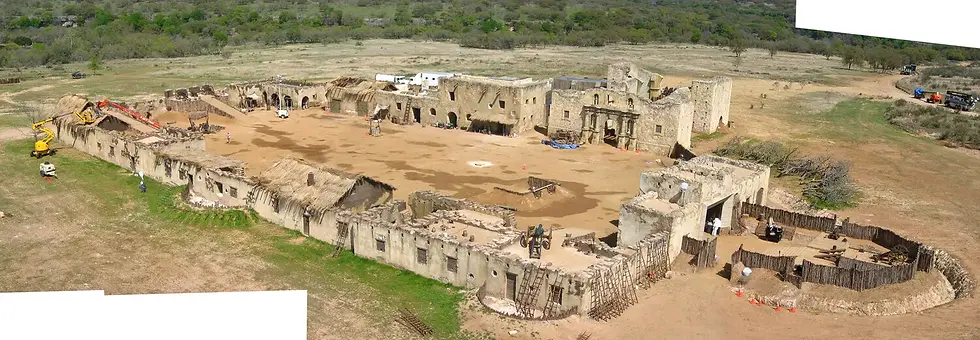
That is the honest shape of a build like this, and it is worth saying to anyone who has ever pitched a permanent backlot off the back of a feature. A picture builds what the picture needs. Turning that into standing infrastructure is a second project with a second business case, and it almost never gets funded by the film that put the lumber up.
The build also tells you what the crew order looked like. Seventy structures is a construction department running for months before a camera turns, which means carpenters, painters, plasterers, laborers and a construction coordinator on payroll through the back half of 2002 and into 2003. On a picture like this the art department is not a line item. It is most of the hiring.
A hundred reenactors is a residency story.
Leydon’s reporting notes that the San Jacinto sequence at Bastrop was filled out with more than a hundred San Antonio based historical reenactors alongside veteran actors and stunt performers. In 2003 that was a casting convenience. Somebody in San Antonio already owned the uniform and knew the drill, and that is cheaper and better than teaching it to a hundred day players.
Under the program as it stands today, that same decision is worth money, and most producers do not think about it until the verification package is due. The residency test for a film or television project counts paid cast including extras as its own pool, separate from crew. A battle sequence staffed out of Texas reenactment groups moves that percentage in the right direction across hundreds of paid days. A battle sequence staffed out of a Los Angeles extras casting office moves it the other way, on the same number of days, for the same footage.
This is the kind of thing that is trivial to arrange in prep and impossible to fix at wrap. The paperwork problem nobody sees coming is residency collected after people have gone home.
Who made it.
John Lee Hancock, a Texan, directed and shares the screenplay with Leslie Bohem and Stephen Gaghan. Mark Johnson produced. Dean Semler shot it. Carter Burwell wrote the score.
Dennis Quaid plays Sam Houston, Billy Bob Thornton plays Davy Crockett, Jason Patric plays Jim Bowie, Patrick Wilson plays William Travis, Jordi Mollà plays Juan Seguín and Emilio Echevarría plays Santa Anna.
Ron Howard was going to direct it. He wanted a harder film, closer to Peckinpah, and pitched a budget around $130 million with an R rating. Disney would not take it. Howard stepped down as director in July 2002 and stayed on as an executive producer with Brian Grazer. The reasons on the record do not fully agree: Variety reported at the time that Howard moved on because the studio was taking too long to get into production and he wanted to use the momentum from A Beautiful Mind, while the budget and rating dispute is the account that has stuck since. Both may be true. Only one of them is a story about money.
The money.
Box Office Mojo carries the production budget at $107 million against $22.4 million domestic and $25.8 million worldwide. Marketing ran a reported $35 million on top. Bomb Report, working from investor filings, puts Disney’s eventual write-down at an estimated $80 million or more.
The picture opened on April 9, 2004 through Buena Vista and took $9,124,701 in its first weekend, fourth for the frame. Box Office Mojo’s own coverage at the time noted the forecast had been closer to $15 million.
Why the release went the way it did.
This is the part everyone skips to and nobody documents, so here is the record rather than a verdict. Four things show up in every contemporaneous account.
The date moved. Bomb Report’s account has the film set as a prestige Christmas 2003 release and pushed to April after Disney said it was not ready. A picture built for awards season that arrives in April is a different picture commercially, whatever is on the screen.
The market was occupied. It opened into a spring in which The Passion of the Christ was still pulling audiences that had been out for weeks. Easter weekend was not empty.
The campaign assumed the audience already knew the story. Brandon Gray, then president of Box Office Mojo, said it directly: “the ads just said ‘this is about the Alamo.’ That’s probably assuming people know more than they do.”
Reviews did not carry it. Rotten Tomatoes settled at 29 percent across 159 reviews and Metacritic at 47. Audiences who did turn up graded it a B on CinemaScore, which is the gap that makes this one interesting. Roger Ebert was the loud dissent at three and a half stars, writing that the film “captures the loneliness and dread of men waiting for two weeks for what they expect to be certain death.” Historian James S. Olson made the opposite complaint in the same coverage: “there wasn’t any sense of why the men were there.”
None of those four is a production failure. The set got built, the schedule held through a Hill Country winter, the film got finished. The things that decided the outcome happened in a marketing meeting and on a release calendar, which is the part of the job a line producer never gets a vote in.

My read.
Austin was proud to host this one. A hundred million dollars was a real number in 2004, it came here, and the town knew it. Crews who worked that build still talk about it.
Texans love this story. It sits at the heart of how the state explains itself, which is what Corenblith meant by creation myth. That is also the trap. A story everyone believes they already own is a hard ticket to sell.
I think it is a pretty good movie. The return was rough. Both of those are true, and the second one is not a ruling on the first.
If you are building instead of finding.
The reason this picture is in a countdown about Texas is that it is the clearest example on the list of a production choosing to build rather than travel. San Antonio has the actual Alamo. It is a shrine in the middle of a downtown, surrounded by two centuries of city, and it could never have held this shoot. So the production put up its own version an hour away, on open land, with the space to light it and burn it and put a thousand people in it.
That decision is available to anyone. Land, a long build window and a crew base are the three things it takes, and Central Texas still has all three. What has changed since 2003 is what the state asks in return. The Texas Moving Image Industry Incentive Program is a cash grant paid after the work is done and verified, not a transferable credit, and it asks that 60 percent of the production be completed in Texas. For a film or television project it asks separately that 35 percent of paid crew and 35 percent of paid cast including extras be Texas residents. That figure steps to 40 percent on September 1, 2027, keyed to the date principal photography begins, so a long build that starts shooting after that date is answering a different question than one that starts before it. Verified against the Commission’s pages in September 2026. Confirm anything you intend to budget against with the Texas Film Commission at 512-463-9200.
If the picture is a build rather than a location hunt, what stage and land actually exist here is the first thing to price, and the producer of record question is the second. When you are ready to put a schedule against it, that is what we do.
Previous in the countdown: #47, Grindhouse. Next: number 45.


Comments