
Selena filled the Alamodome with about 34,000 unpaid extras in one day so it could play the Astrodome.


If you are looking for where Selena was filmed, the answer is San Antonio and Corpus Christi, with work in Poteet, Lake Jackson, Aransas Pass and Houston. San Antonio Magazine, looking back on the shoot, says the San Antonio work ran through September 1996 before the company moved on to Corpus Christi, Lake Jackson and Poteet.
It is a Texas story told in Texas. Selena Quintanilla Pérez grew up in Corpus Christi and died there on March 31, 1995. Warner Bros. released the film less than two years later, and her family was part of it from the start.
The casting call came first.
Before anyone shot a frame, there was the search. The Texas Film Commission records the San Antonio open call on March 16, 1996, at Market Square, where more than 6,000 people auditioned for the title role. Wikipedia puts the national total, across several cities that week, above 21,000. The part went to Jennifer Lopez.
The Alamodome played the Astrodome.
The scene the film is built around is the Houston Astrodome concert, and the Astrodome is not where they shot it.
On Sunday, September 15, 1996, the production filled the Alamodome in San Antonio. San Antonio Magazine reports about 34,000 extras seated in roughly half the arena in about thirty minutes, fans lining up twelve hours before the doors opened, and thousands waiting by nine in the morning. They were unpaid volunteers. They got posters, buttons and T-shirts. The concrete floor was covered in sawdust, dirt and wood shavings to read as the Astrodome’s rodeo floor.
The count is usually given as 35,000, which is what this series’ own record says. The best contemporaneous account I could read says about 34,000, and that is the figure I am using.
That is the cheapest crowd of that size anyone is likely to put on screen, and it worked for one reason. The people in the seats wanted to be there.

What was real and what stood in.
Some of it is the real place. The Texas Film Commission’s film trail lists Swantner Park in Corpus Christi, on the bay, where young Selena learns to dance cumbia from her mother, and calls it a significant backdrop of the film. The San Antonio River Walk is where Selena and Chris walk after they marry.
Some of it is Texas playing somewhere else. Poteet, south of San Antonio, stood in for the open-air concert in Monterrey, Mexico. Del Mar College in Corpus Christi stood in for the Grammy ceremony, per the Film Commission trail.
The record I started from also lists the Quintanilla houses on Bloomington Street and the Q-Productions studio as locations. I could not confirm either in a source I could read, so they are not in this post until someone confirms them.
The family.
Abraham Quintanilla, Selena’s father, was an executive producer, with a say from script through casting. Speaking to ET on the film’s twentieth anniversary, he said he wanted the world to know about his kids. Suzette Quintanilla said the family needed that control so Selena would be portrayed accurately. The family also hosted Lopez while she prepared for the part.
Who made it.
Gregory Nava wrote and directed. Moctesuma Esparza and Robert Katz produced. Edward Lachman shot it, and Cary White designed it.
Jennifer Lopez is Selena. Edward James Olmos is Abraham. Jon Seda is Chris Pérez, with Constance Marie, Jacob Vargas and Lupe Ontiveros in the family and the business around her.
The money.
Warner Bros. released it March 21, 1997. It opened to $11,615,722 on about 1,850 screens. Box Office Mojo records $35,764,351 domestic, which places it at thirty nine on this list. The Numbers has $35,868,790. The budget was $20 million, per The Numbers and San Antonio Magazine.
The Houston Chronicle reported that Lopez was the first Latina actress to earn a $1 million paycheck for a role, and she was nominated for a Golden Globe. The Library of Congress added the film to the National Film Registry in December 2021, after a push from the Congressional Hispanic Caucus.

Why people love it.
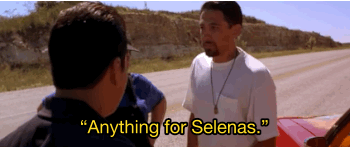
Iconic performances, an iconic soundtrack, and lines people still say. Anything for Selenas is still said to this day, by people who were not born when it came out.
Roger Ebert’s review gave the credit to Lopez for evoking the magic of the real performer. That is the whole film.
My read.
This is the movie that introduced Selena to everyone who did not already know her, and the one that put Jennifer Lopez on the map as a real star.
It also has true Texas roots, and it shows the size of the state. Corpus Christi on the coast, San Antonio’s River Walk, a South Texas farm town playing Mexico, a stadium full of people who came because they loved her. The variety of people and places in it is the point.
The producing lesson is the Alamodome day. A crowd shot that size would sink most budgets. This one cost T-shirts, because the production asked the right community for help and the community showed up.
What this means if you are scoping a Texas shoot.
San Antonio and Corpus Christi are about two and a half hours apart. Both have stadiums, historic districts, coastline or river, and a deep bench of people who will turn out for a production they care about. San Antonio also runs its own local incentive on top of the state program; the city’s program page has the current terms, and the Texas Film Commission at 512-463-9200 is the only one who can tell you whether a project qualifies for the state side.
The previous entry in this countdown is number 40, Places in the Heart. The full countdown lives here. For screening in the region, see San Antonio and South Texas: every independent screen a filmmaker can book. If you are scoping a South Texas shoot, start here.
Next in the countdown: number 38.


Comments