
Man of the House got something no other film has gotten from the University of Texas.

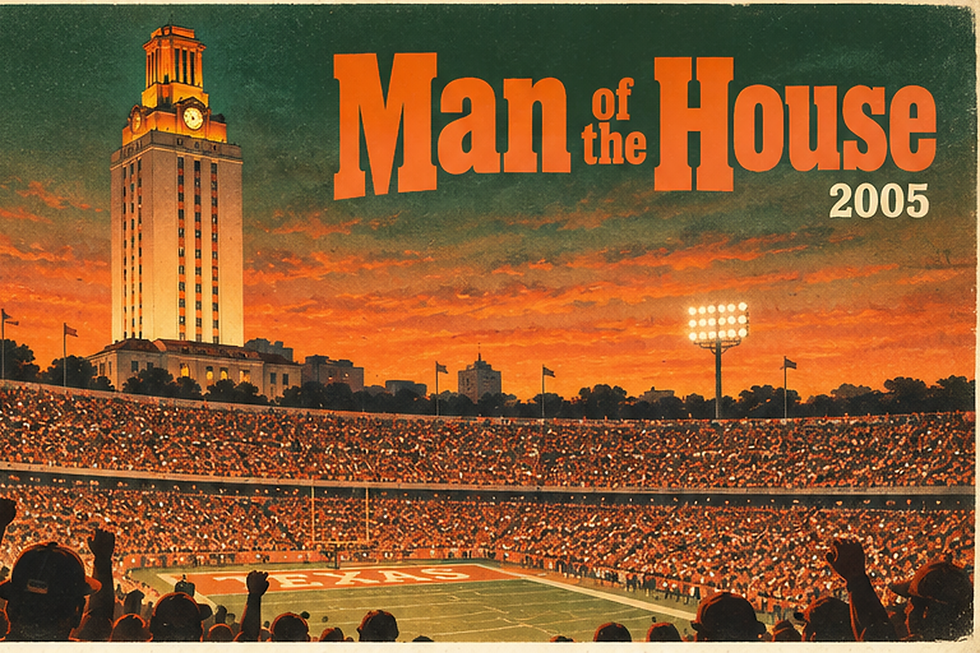
TEXAS TOP 50; #50 Man of the House (2005)

If you are looking for where Man of the House was filmed, the answer is Austin, and more specifically the University of Texas campus during a live football season. The 2005 Tommy Lee Jones comedy shot from October to December 2003 on the Forty Acres, in West Campus, and inside Darrell K Royal-Texas Memorial Stadium.
What makes it worth a producer's attention is not the comedy. It is the access. This is a studio film that put the actual name of the University of Texas, its stadium, its band and its cheerleaders on screen, and that is a harder thing to obtain than a stage or a permit.
What was shot where.
The production was based in Austin and worked out of real locations rather than sets. The main house is at 612 West 22nd Street in West Campus, the kind of aging student rental that anyone who went to UT recognizes on sight. The opening runs through the Warehouse District downtown. Threadgill's, since closed, plays the restaurant where Jones's Texas Ranger meets his daughter. Buffalo Billiards, also since closed, is the bar. There is a skating sequence at what was then the Millennium Entertainment Complex.
Then there is the stadium. The Austin Chronicle described the film as striding "from the dorms of West Campus to Darrell K Royal-Texas Memorial Stadium, with a genuine Longhorn game as background," and that is the part worth pausing on. The crowd is not background actors. It is a real Saturday.
One correction to the record that circulates about this film. The Cactus Cafe turns up on location lists, but in the film it is a line of dialogue rather than a location: the characters say they are going there to see Asleep at the Wheel. Worth knowing if you are building a location tour off somebody else's list.
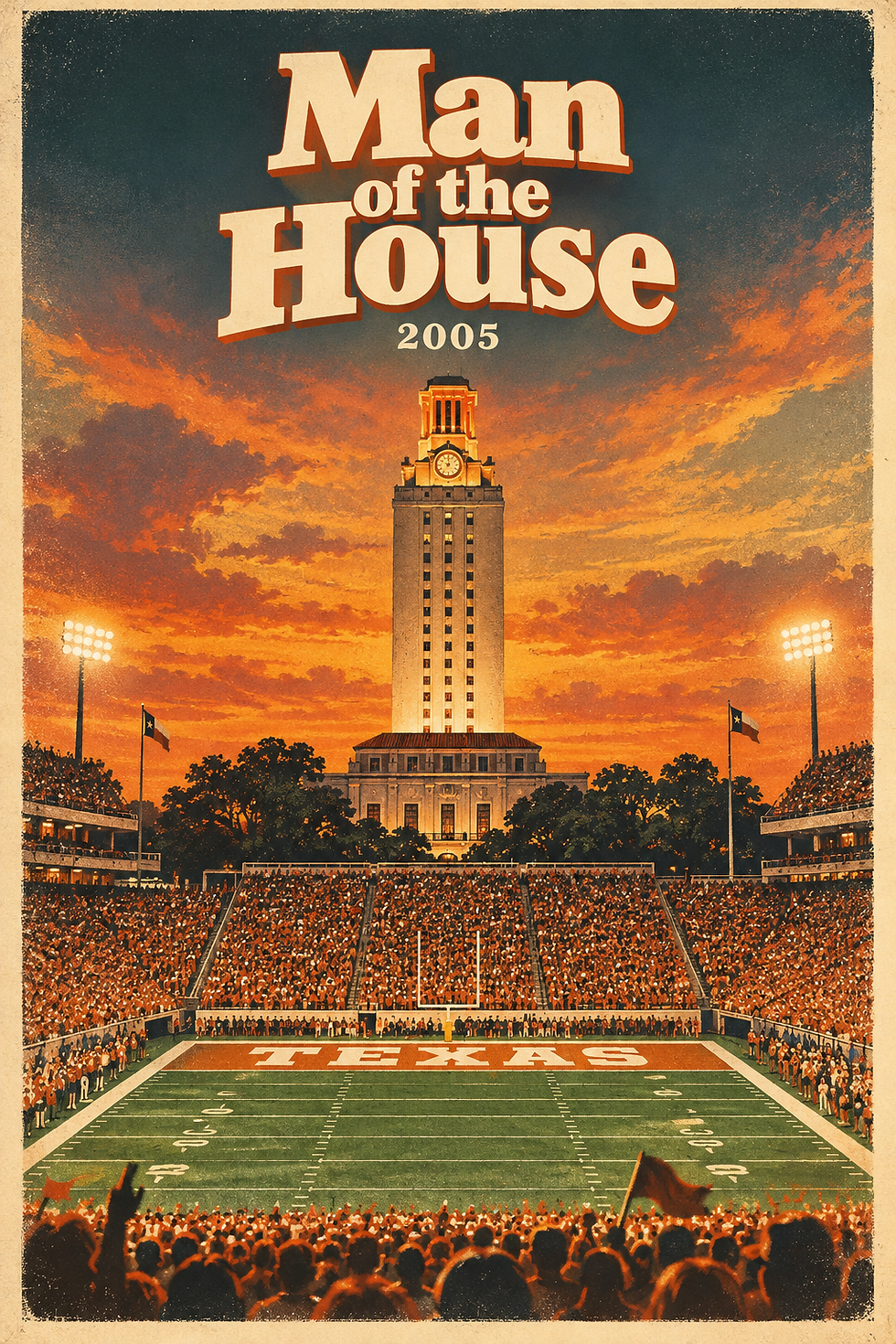
The access is the story.
Reviewing the film in March 2005, The Astorian put the arrangement plainly: "How many other movies have been allowed to feature the University of Texas' logos, mascots, band and cheerleaders? Answer: None. Man of the House is the first movie allowed to use the full and actual name of the University of Texas in Austin and to use well-known UT symbols."
That is a reviewer's assertion rather than a statement from the university, and I have not found the deal terms published anywhere. But the film itself is the evidence. The marks are on screen, the stadium is on screen, the band and the spirit squad are on screen, and they are identified as what they are. Anyone who has tried to clear a university's athletic marks for a commercial project knows what that represents.
The stadium was still called Joe Jamail Field at the time. Governor Rick Perry appears as himself.
What a real game day costs you.
Shooting inside a live event is a specific discipline and it is worth spelling out, because it looks free and it is not.
You get one take of the thing itself. The crowd does what it does. The light is whatever the light is at kickoff. Your camera positions are agreed weeks out with people whose job is the event, not your film, and they will move you if you are in the way of the broadcast. Your talent has to be in position and in costume before the gates open, and stays until the stadium clears. Nothing about the day belongs to the production.
What you get for it is a hundred thousand people you did not have to hire, dress or feed, and an authenticity no amount of background casting reproduces. On the schedule it is one immovable date that everything else is built around.
Who made it.
Stephen Herek directed. His run before this was unusually broad for a studio director: Bill and Ted's Excellent Adventure, The Mighty Ducks, Mr. Holland's Opus, the 1996 101 Dalmatians. He is a Texan, born in San Antonio, and he came back to shoot here.
The screenplay is credited to Robert Ramsey, Matthew Stone and John J. McLaughlin, from a story by McLaughlin and Scott Lobdell. Ramsey and Stone had written Life and Big Trouble; McLaughlin would go on to write Black Swan and Hitchcock. Producing were Steven Reuther, Todd Garner and Allyn Stewart.
Tommy Lee Jones leads as Roland Sharp, a Texas Ranger assigned to protect five UT cheerleaders who witness a murder. Jones is from San Saba, went to Harvard, and by 2003 had an Oscar for The Fugitive. Anne Archer, Brian Van Holt, Christina Milian, Paula Garces and Monica Keena fill out the cast. Cedric the Entertainer plays a preacher.
Critics who liked it liked Jones. The Astorian called him "one actor who has found his niche in Hollywood and plays it brilliantly every time." Dana Stevens, writing in The New York Times, noted that "Mr. Jones's dry delivery has its moments."
The money.
Sony released it on February 25, 2005. It earned $19.7 million domestically and $1.9 million overseas, for $21.6 million worldwide against a budget reported between $40 and $50 million, according to Box Office Mojo and The Numbers, which disagree on the budget figure.
That is the number that puts it at fifty on this list. It is also a useful reminder that box office and production value are different measurements. The film bought a lot of Austin.
What was happening on that campus in 2003.
Worth setting the scene, because the season the cameras were there turned out to matter. Chance Mock, a junior, started the first six games of the 2003 Longhorns season. A redshirt freshman named Vince Young was behind him, taking a growing share of the snaps, and in the seventh game, at Iowa State on October 18, Young took the job and did not give it back. He finished the season two yards short of becoming the third freshman in NCAA history to pass for a thousand yards and rush for a thousand in the same year.
Two seasons later he would win a national championship in the Rose Bowl. The film was shooting on that campus while that was starting.

My read.
Iconic locations, and the film knows it. You have the UT football cult as a backdrop: the stadium, the campus, the Tower. This oozes Austin in a way very few films manage, because most productions that come here are using Austin to play somewhere else.
It is also one of those movies that pops on while you are in a hotel room and you leave it on, because it feels like home. That is not a critical judgment. It is an accurate description of how a film shot in your own city works on you.
For a producer, the transferable lesson is about institutional access. Stages and permits are logistics, and Texas has plenty of both. What is scarce is the cooperation of an institution with a brand to protect, and that is negotiated months out, by people who have a reason to trust the production. Nobody clears a university's athletic marks in a week.
If you are looking at a Texas campus.
Campus shooting here is its own discipline. The academic calendar, athletics, the university's own communications office and the city permit all have to line up, and a real game day is the least flexible date on the list. That work starts long before a location scout goes out.
I have written about where Texas doubles for somewhere else, and about what an out-of-state show actually needs on the ground here. If you are planning something on a Texas campus and want to know what the ground conditions actually are, start here.
Next in the countdown: number 49.


Comments